Sunday, July 26, 2015

Why we need to speak up for Exporters and support small business!

Whoa let's stop the madness, Small Business needs the Export-Import Bank! Speak up!

As a service provider to small manufacturers I am concerned about the expiration of the Ex-Im Bank reauthorization. My clients, many of which are small manufacturers benefit from this service. Every citizen should understand the value of this service and I ask you to write to your congressman/senator in support of getting the authorization passed.
My clients have export opportunities in South America and Africa. They want to expand globally and thereby need my translations and international business consulting. The Export-Import Bank enables exports to happen, sales to happen, services like mine to build revenues and more. The ancillary services and companies that support U.S. manufacturers will be negatively affected if not passed.
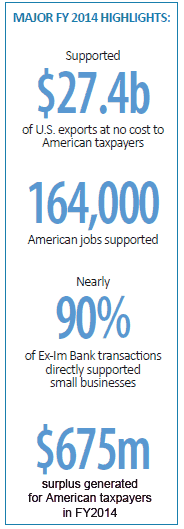
Has anyone considered all the companies, business owners, employees who will be affected? Thousands of jobs depend on exporting! The Export-Import Bank creates wealth, does not cost the taxpayers money, and increases taxes paid into our system. Why are the law makers fighting something that is win-win for all across party lines? It is frustrating as a business owner and U.S. citizen to see the efforts spent on this issue, this should not be an issue at all. 

Please write to your elected official and tell them we demand the authorization go through.  Your efforts are appreciated.

Export-Import Bank Facts:

There are over 60 other credit agencies around the world.
The EXIM Bank generated almost $7 billion more than the cost to run their operations. 

Wednesday, July 8, 2015

International understanding – Who’s reading your message?


Recently, I was speaking with manufacturers about translations and building business abroad. We discussed translating marketing materials and operating manuals into other languages. One person stated everyone speaks English. YIKES! How is it we are still so arrogant as a nation?

It reminded me of the newspaper article I read a few years ago about a Mexican visitor flying into an American International Airport. He wandered around for five hours looking for the exit. You see, at my regional international airport you need to take an underground tram to and from the entrance, baggage area and outside transportation. The airport had all of the “proper” signage and still he couldn’t find the exit. Why? He like many Americans who travel abroad do not read or speak the native language. We Americans are naïve to the needs of others. We fly into international cities that welcome us with signs in our native language. Although, it can be a culture shock to travel to a city in another country it is doubtful we will not have the aid of English signage or speakers in our travels, it’s doubtful we will be lost in translation.

To build international relationships, we need to have a mutual understanding in English first. 

Examples:
I spoke with a large university in Virginia with an international student department. They wish to increase their foreign student population. Their website listed student activities, studies, campus life and more. It was engaging and impressive. First error is an English only website. Even worse, the telephone numbers to contact the department do not have our international code +1 or the area code. It will be very difficult for a parent or organization looking to send their child to this American University to know how to telephone them. Shouldn’t we make it easy for others to do business with us?
Understanding that French speakers are very literal, writing a statement like “our services include” will not be as clear as “our services can include”.  Adding can makes a great difference in discussing customizing services.
Understanding when negotiating with Chinese professionals, they will agree and you think you are done. They will come back to the negotiating table to talk again and again all the time agreeing with your statements. Agreeing, nodding their heads is an act of respect more than consent.
Understanding safety training for a native Hispanic, he/she will probably agree to the safety training and then put themselves in an unsafe environment or situation from fear of not getting the job done and losing their job. Training must be approached differently, focusing on repercussions if the proper process is not followed and rewards when they do act safely.
Often people are writing content quickly to get published. I have seen homonyms used that muddle the message. This error is often overlooked by native English speakers because the understanding is automatic. A translator who is not native to the source language will often not understand the context of the sentence. Confusing homonyms that I have seen in English when translating:
Wonder               Wander
Are                         Our
There                    Their
Flower                  Flour
Affect                   Effect
Oar                         Ore

When you reach out to other cultures and countries to promote your business, organization and work, think of the Mexican businessman that wandered in an American International Airport for five hours trying to find a way out. Let’s make it easy to work with us, talk with and visit us. Put yourself in other’s shoes and communicate to be understood!


Author:
Linda Richardson, President        linda@allcleartranslations.com @allclearlinda
All Clear Translations www.allcleartranslations.com


Monday, June 29, 2015

7 Low Cost Ways That Improve Worldwide Lead Generation

Be like the coffee bean - Be found anywhere and everywhere!

Reach global markets with low cost changes      

by Linda Richardson

 1. Create videos promoting your company and product. YouTube is the 2nd largest search engine in the world!

2.  Add Closed Captioning to your videos on You Tube. Increase being seen with text added to the video. Translate it and add more languages to be found in the regions you are entering. https://support.google.com/youtube/answer/2734796?hl=en

3.  Localize your app – 7 Billion Mobile-Cellular Users Worldwide! Emerging Markets growth for mobile use is exploding.
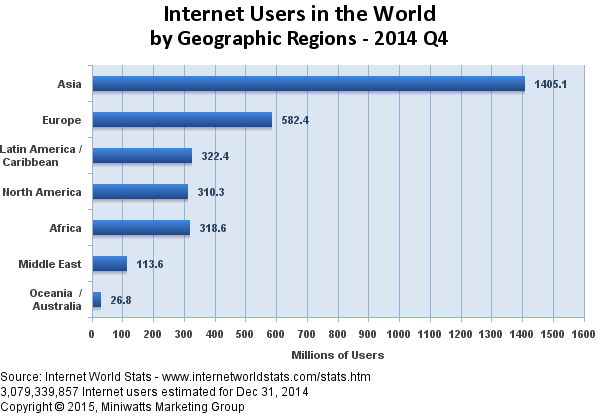
4.  Add the top 3 internet languages to your website and be found by most internet users

 world internet users

 5. Tweet – get with it! 80% of Twitter users are mobile and 77% of Twitter accounts are outside of the U.S. There are 33 languages supported by Twitter. Add Real-time languages and boost your visibility

 6. Facebook – 93% of Worldwide Marketers use Facebook to market their company/product

 7. US Commercial Service Tradeshows – Take advantage of the US Commercial Service Trade Booths. They will market for you, drive customers to their booth and have grants to help you with the costs of International Trade Shows.


Need help with translations, languages, cultural marketing? Give us a call 412.496.5105 or email Linda Richardson directly, 412.496.5105.


Tuesday, April 28, 2015

International Partner Search Consultative Services


All Clear Translations LLC expands services.

Our clients asked and we listened! We now offer consultation services to help with International Partner Search. Our consultants will help you open new markets in South America, Latin America, Mexico, Morocco, Switzerland and France.
Our International partner development consultant will help small and medium-sized companies develop and enter new global markets. We will provide global business expertise to mentor international new market development initiatives for companies wanting to become proactive in expanding their sales in emerging global industrial markets. We offer native Spanish, German and French fluency with extensive on-site business development experience in Hispanic and French and Switzerland markets.

Services include:
* International partner search
* New market entry strategy development
* Sales distribution channel development
* International sales and cultural coaching
* English-Spanish interpretation services

Contact Linda 866.489-9109 linda@allcleartranslations.com to discuss how we can help you successfully build international connections and sales.


Monday, April 27, 2015

GLOBAL READY? HELP IS HERE!


Y


This is part 2 of the last blog. You have decided to move forward with exporting sales. Questions my clients have asked will be addressed here.
1 How to determine if there is a market in this country for my product?
2. What specific companies have a need for my product?
3. How do I find out if this is a viable market before signing with an in-country agent?
4. What do I do about the language barrier?

What market should you focus on? Is the best market in Chile, Peru, China, Korea or elsewhere? There are government resources to help you with the basic marketing research. Check with your local SBDC (Small Business Development Center), your state department of trade.  Working with these advisers, you will determine what are possible targets and who might be buying what you are selling.

Once you establish a possible regional target, you may want to use a service to make some preliminary calls into the companies you are targeting to see if there is a match. Hiring a consultant that knows the region and is bi-lingual will enable you to understand better the potentiality of that market. We provide such consultants for Latin America, South America, France, Morocco and Turkey. The next step, use that bi-lingual consultant to make contact with in-country reps that can represent your company.Understanding is key, so be sure to translate your information and use an interpreter or bi-lingual consultant to speak for you.

By proactively searching and researching your new markets you will reduce the costs and time it may take to establish a market in new countries. Take advantage of state and federal trade missions offered through your state and the US Commercial Service. Your trade association may offer trade missions as well. They know your industry and can offer valuable connections internationally. Participation in a trade mission helps ease the burden of travel, setting appointments, language barriers and more.

Patience is key to developing a new market. It will not happen overnight and doing your due diligence up front will help you create a good plan of entry. If you are looking for help on establishing a new market, our consultants can help you sail the export seas to new lands and new sales. Please contact Linda at linda@allcleartranslations.com to discuss your specific needs. Together let's determine if we can help.

Resources Directory
https://www.wtca.org/ World Trade Centers
http://www.export.gov/   US Commercial Service   


Tuesday, March 24, 2015

You are Global Ready NOW! Find that In-Country Sales Agent or Distributor


New Markets are opening for your product. How do you decide to use an in-country sales rep (agent) or distributor?


You did all the work, researched, educated yourself and staff, went to seminars, workshops and more. You worked with the SBDC, US Commercial Service, your State Agency, local economic development and connected with tens of people who all want to see you make it here and sell it anywhere.

Now, how do you connect with the right sales agent? Will they correctly communicate your message or image ? Or will they sell sex, drugs and your product? Pictured is a shop in Israel that sells olive oil and ... Be sure your new sales agent/rep or distributor honors your product. Decide whether you use a distributor or sales agent/rep – better yet what is the difference?


In-Country representation is needed to build your brand.  You may want total control over the message, the distribution, pricing, etc. If you do then a rep is the best choice. A sales representative acts as your salesperson. They represent your company by creating connections with potential buyers and arranging the sale of your products in country. He or She is usually an independent contractor who gets a commission off of the products sales they make.

Working with sales reps (agents), allows you to maintain control over the translations, marketing message and distribution. Many of my clients have chosen this path knowing the translations are maintained by a professional agency whose first concern is the client’s message. The message is consistent with their branding and complies with safety guidelines.

 A distributor will buy your products at wholesale and resell them to their customers in that region or country.  The distributor will maintain an inventory and have ownership of the products they purchased from you. The distributor takes care of all the functions of a business in their country. You keep manufacturing your products; they market them, have an inventory and distribute them. The distributor places orders with you. Your main concern is manufacturing not managing the sales abroad. You have less control with a distributor.

When choosing a distributor, one problem our clients have had is not maintaining a consistent message. If you choose a distributor, ask if you can create the marketing and maintain the translations in house. This will enable you to maintain a consistent brand and information.

Points to consider when talking with a potential sales agent/distributor:

  • How fluent are they in your language? 
  • Is there a language barrier?
  • Do they have clients that are competitors?
  • Are their clients in vertical markets?
  • How well do they know your industry and product?
  • Do they have current clients that you can talk with?
  • Are they established?
  • What is their reputation?
  • Shipping/Logistic concerns?
The next blog will address some avenues you can take to find that sales agent/distributor. 

We can help you with all of your language translations needs! Please visit us at www.allcleartranslations.com or email me directly Linda@allcleartranslations.com

Friday, March 13, 2015

I am excited to meet Terri Morrison author of my favorite International Business Guide!


Have you ever had the opportunity to meet an expert, celebrity, politician that you follow?  I have that opportunity on March 26th when Terri Morrison author of "Kiss Bow or Shake Hands" will be speaking at the Meadville Country Club. This event sponsored by the Northwest PA Commission is going to be a great time. Hearing what Terri has to say about culture and international business will be educational and entertaining. Terri sent her article, Bad Brands and Translation Blunders to share with my wonderful readers!

Bad Brands and Translation Blunders: I Love You, and other foreign language faux pas     by Terri Morrison


    As Alexander Pope said, “A little knowledge is a dangerous thing.” But could learning just a few phrases in a foreign language actually be hazardous? Yes and no.
    In Madrid a few years ago, some coworkers and I stopped at a café for coffee. At least that’s what I ordered. My associate from England was more interested in a lovely cup of tea. But as he looked up at the stunning Spanish waitress, his basic Spanish 101 request came out as “Te quiero” (I love you) instead of “Quiero té” (I want tea). Lucky for him, the waitress smiled – and sat in his lap!
Of course, he was dead chuffed (utterly delighted) and now loves Spain. However, language blunders and poor translations rarely work in our favor.
    Many global firms have struggled with poor translations of everything from annual reports to brand names. Appropriate translations can be particularly challenging in a language that has a different writing system. In written Chinese, characters can represent abstract ideas, so names are very evocative. A poor choice is more than embarrassing; it can sink your business. But propitious ones sell products.
    Adam Wooten, director of translation services at Lingotek (visit lingotek.com), described how Microsoft’s search engine, Bing, eluded disaster in China. “Some Chinese characters that sound like Bing can mean “sick” or have other negative connotations – which would not bode well for Chinese Internet users.” Fortunately, Microsoft identified this problem in its research and added another Chinese character, changing the pronunciation to Bi-ying. “Bi-ying basically means ‘certain to respond’ – a very auspicious phrase for a search engine,” Wooten says.
    For every good Bi ying, or Kekou Kele (Coca-Cola’s Chinese moniker means “Delicious Happiness”) there are as many corporate brand name blunders. Check out these faux pas and see if you can match the tacky name with its company.
1) Incubus
2) Mondelēz
3) Air Bakin’, Air Grill, etc.
4) Bensi

A) Nike
B) Mercedes Benz
C) Reebok
D) Kraft

Answers:
1, C: Yes, Reebok named a sneaker after a mythological demon who rapes women at night. It flopped.
2, D: Mondelēz (pronounced Mohndah- LEEZ) is the new name for Kraft’s $35 billion snack foods company.
Basically Mondelēz violates three rules for a new brand name:
    If you need the Oxford Guide to Etymology to explain how the word is pronounced and what it means, then it probably won’t be easy to remember.
If the word or acronym has any unpleasant connotations anywhere in the world, you might want to skip it. A little research reveals that in Russian, Mondelēz is a lewd, crude, and socially unacceptable
term. If you’re targeting Oreos consumers, you should probably strive for a PG rating.
    Can you write it right? In Mondelēz, the line above the second ‘e’ (called a “macron”) is not even consistently rendered in Kraft’s press releases. The Wall Street Journal reports a Kraft spokesperson saying: “This makes our marketing people sad.”
3, A: Nike was forced to recall thousands of pairs of Air Bakin’, Air BBQ, Air Grill, and Air Melt shoes because of a decoration intended to resemble fire on the back of the sneakers. Unfortunately, when viewed from right to left (which is the way Arabic is read), the flames resembled the Arabic
word for Allah. Muslims saw this as a desecration on two levels:
The name of Allah may not be used on a product.  Arabic tradition deems the foot unclean. Facing worldwide protests and boycotts, Nike recalled the expensive sneakers. (On the good side, Nike’s brand name in China is Naike, which works well because it relates to endurance and perseverance.)
4, B: When Mercedes-Benz was initially translated for the Chinese market, it was rendered Bensi, which means “rush to die.” Fortunately, Stuttgart management made some changes and the brand became Benchi, or “run quickly as if flying.” Translation blunders are obviously embarrassing and expensive. But multinational firms seem at a loss sometimes to avoid errors in global communications. They turn to marketing research firms and forget about quality translations. Having your collateral translated well the first time is not only cost effective, it demonstrates respect for
your prospects and clients.
    As Nelson Mandela said, “If you talk to a man in a language he understands, that goes to his head. If you talk to him in his language, that goes to his heart.” Finding professional translators is relatively easy these days. LinkedIn has translation groups filled with professionals who would love to
help. Try LinkedIn’s Language Jobs group (with over 20,000 members), Localization Professionals group, or the American Translators Association to start, and post your jobs and questions in front of pros.

Terri Morrison is a speaker and co-author of nine books, including Kiss, Bow or Shake Hands: The Bestselling Guide to Doing Business in More Than Sixty Countries, and her new book, Kiss, Bow or Shake Hands: Sales & Marketing. She is president of Getting Through Customs, developers of
Kiss Bow or Shake Hands Digital - available through McGraw-Hill Digital. Twitter @KissBowAuthor. Visit TerriMorrison.com

We can help you with all of your language translations needs! Please visit us at www.allcleartranslations.com or email me directly Linda@allcleartranslations.com