Showing posts with label Language Translations. Show all posts
Showing posts with label Language Translations. Show all posts
Monday, January 11, 2016
Change Can Lead To Global Impact
Come
explore my world at GlobalDoc, Inc.
I am excited to join forces with GlobalDoc, Inc. as their Director of Business Development
for the U.S.A. Effective August 22nd,
All Clear Translations, LLC operates as GlobalDoc, Inc. GlobalDoc enables me to
offer my clients a superior support system in all languages. GlobalDoc's LangXpert®is
an amazing automation tool enabling seamless translation workflow between GlobalDoc
and our clients.
As you may know, I
started All Clear Translations in late 2010. My focus was to offer our clients
the best technically efficient translations for all their software and user
interface needs. As an entrepreneur working in and on my company, my funding
limitations to build a technologically advanced service became apparent. Much
has changed in the localization industry! I couldn't build an infrastructure to
give clients ease of use that maximizes technical advances in IT and
translation. I contemplated how to continue to provide my clients with
the best possible solution for their translation requirements in this ever
changing industry. Enter our hero – GlobalDoc
-when CEO/President Mike Cooper reached out to me. It seems we are a great fit!
Working with Mike and his team enables me concentrate on meeting my client’s
needs. Together with GlobalDoc, I can
make their language workflow easier for them now by having access to more
technical tools and a wider range of resources, including a global support structure.
Change can be hard but
is good! Too often people shy away from a big change. We can amaze people and
ourselves when we think outside the box. If we think about the most innovative
companies like Google, Microsoft and Velcro® Brand, their solutions answered a need, were revolutionary and game
changing. I believe working with GlobalDoc will be a game changer for my
clients now and in the future.
GlobalDoc is an
international translation service with the tools to help my clients from
anywhere in the world. I believe we all need to embrace change, whether it is
new technology, new regions to develop or new employment. Significant change is often a catalyst to
bigger ideas and solutions. Sometimes the change is changing your dream to
embrace working with someone that can make dreams happen. Gotta love that,
right? I will still write about changes in our industry, exporting, and regions
around the world. Watch for my GlobalDoc blog soon!
I won't have to breathe fire to delight our clients!
Recently, I was speaking with manufacturers about
translations and building business abroad. We discussed translating marketing
materials and operating manuals into other languages. One person stated
everyone speaks English. YIKES! How is it we are still so arrogant as a nation?
It reminded me of the newspaper article I read a few years
ago about a Mexican visitor flying into an American International Airport. He
wandered around for five hours looking for the exit. You see, at my regional international
airport you need to take an underground tram to and from the entrance, baggage
area and outside transportation. The airport had all of the “proper” signage
and still he couldn’t find the exit. Why? He like many Americans who travel
abroad do not read or speak the native language. We Americans are naïve to the
needs of others. We fly into international cities that welcome us with signs in
our native language. Although, it can be a culture shock to travel to a city in
another country it is doubtful we will not have the aid of English signage or
speakers in our travels, it’s doubtful we will be lost in translation.
To build international relationships, we need to have a
mutual understanding in English first.
Examples:
I spoke with a large university in Virginia with an
international student department. They wish to increase their foreign student
population. Their website listed student activities, studies, campus life and
more. It was engaging and impressive. First error is an English only website. Even
worse, the telephone numbers to contact the department do not have our
international code +1 or the area code. It will be very difficult for a parent
or organization looking to send their child to this American University to know
how to telephone them. Shouldn’t we make it easy for others to do business with
us?
Understanding that French speakers are very literal, writing
a statement like “our services include” will not be as clear as “our services
can include”. Adding can makes a great
difference in discussing customizing services.
Understanding when negotiating with Chinese professionals,
they will agree and you think you are done. They will come back to the
negotiating table to talk again and again all the time agreeing with your
statements. Agreeing, nodding their heads is an act of respect more than
consent.
Understanding safety training for a native Hispanic, he/she
will probably agree to the safety training and then put themselves in an unsafe
environment or situation from fear of not getting the job done and losing their
job. Training must be approached differently, focusing on repercussions if the
proper process is not followed and rewards when they do act safely.
Often people are writing content quickly to get published. I
have seen homonyms used that muddle the message. This error is often overlooked
by native English speakers because the understanding is automatic. A translator
who is not native to the source language will often not understand the context
of the sentence. Confusing homonyms that I have seen in English when
translating:
Wonder Wander
Are Our
There Their
Flower Flour
Affect Effect
Oar Ore
When you reach out to other cultures and countries to
promote your business, organization and work, think of the Mexican businessman
that wandered in an American International Airport for five hours trying to
find a way out. Let’s make it easy to work with us, talk with and visit us. Put
yourself in other’s shoes and communicate to be understood!
This is part 2 of the last blog. You have
decided to move forward with exporting sales. Questions my clients have asked
will be addressed here.
1 How to determine if there is a market in this
country for my product?
2. What specific companies have a need for my
product?
3. How do I find out if this is a viable market
before signing with an in-country agent?
4. What do I do about the language barrier?
What market should you focus on? Is the best market in
Chile, Peru, China, Korea or elsewhere? There are government resources to help
you with the basic marketing research. Check with your local SBDC (Small
Business Development Center), your state department of trade. Working with these advisers, you will
determine what are possible targets and who might be buying what you are
selling.
Once you establish a possible regional target, you may want
to use a service to make some preliminary calls into the companies you are
targeting to see if there is a match. Hiring a consultant that knows the region
and is bi-lingual will enable you to understand better the potentiality of that
market. We provide such consultants for Latin America, South America, France,
Morocco and Turkey. The next step, use that bi-lingual consultant to make
contact with in-country reps that can represent your company.Understanding is key, so be sure to translate your information and use an interpreter or bi-lingual consultant to speak for you.
By proactively searching and researching your new markets
you will reduce the costs and time it may take to establish a market in new
countries. Take advantage of state and federal trade missions offered through
your state and the US Commercial Service. Your trade association may offer trade
missions as well. They know your industry and can offer valuable connections
internationally. Participation in a trade mission helps ease the burden of
travel, setting appointments, language barriers and more.
Patience is key to developing a new market. It will not
happen overnight and doing your due diligence up front will help you create a
good plan of entry. If you are looking for help on establishing a new market,
our consultants can help you sail the export seas to new lands and new sales.
Please contact Linda at linda@allcleartranslations.com
to discuss your specific needs. Together let's determine if we can help.
As a vendor of international communications in the form of translations and telephone interpreting, I am always grateful when working with a client that visualizes a bigger picture, a way to help companies in many countries and understands the way to grow is with a global solution.. TrackAbout is a dynamic and innovative asset tracking solutions company that immediately saw the benefits of reaching a global audience for their clients. Their marketing and sales initiatives were always on a global scale. They have created a proprietary asset tracking solution for clients in many languages using All Clear Translations. We have helped them create a multilingual solution that will be read by end users the world over, thereby making it easy for clients to use it in any region. Please read Christine Span's blog to understand how languages will benefit your clients, sales,and end users.
BY CHRISTINE SPAN - MARKETING SPECIALIST for TrackAbout
As a result of efforts like the General Agreement on Tariffs and Trade (GATT) and organizations like the World Trade Organization, economies across the globe are becoming increasingly intertwined as economic barriers continue to diminish. The Internet has fueled globalization by creating a cheaper, easier and faster means of communication, providing a pool of limitless information and advancing e-commerce. As a result, the international market isn’t so dependent on national borders anymore.
As economic globalization continues to grow, English is increasingly considered a core competency. A report by EF Education First states, “Around the world, companies are conducting more and more of their business in English. Those that are not may be lagging behind their competitors.” The report also states that English proficiency among adults is rising worldwide, and that high English proficiency correlates with the ease of doing business.
Furthermore, according to the Harvard Business Review, “More and more multinational companies are mandating English as the common corporate language – Airbus, Daimler-Chrysler, Fast Retailing, Nokia, Renault, Samsung, SAP, Technicolor, and Microsoft in Beijing, to name a few – in an attempt to facilitate communication and performance across geographically diverse functions and business endeavors.”
Given this evidence, it might seem that there is no need for software globalization. Surely, if English is key to business success, the burden is on the end user to learn English. The truth is that the rise of English proficiency among adults is far from uniform in all countries and all populations. According to the EF Education First report, “Asian countries have a wide range of proficiency levels, from high to very low, with dramatic progress alongside persistent stagnation.” Similarly, “Almost all countries in Latin America, the Middle East, and North Africa have low or very low English proficiency. Although a few countries are improving in these regions, most are not.”
While English is the global language of business, not all software users speak English. Not all speakers of English as a second language are able to use the language in their daily work. At the end user level, they may only know enough English to get by. This isn’t acceptable in the real world business environment where all users need to understand and use the software accurately and quickly.
Multinational companies want standardized solutions that can be used across their global locations. But if their end user employees are challenged by a language barrier, the efficiency of the operation suffers. IBM project managers Kenneth McKethan, Jr. and Graciela White wrote, “Software that is available in the user’s own language and runs on a localized operating system provides a great convenience to the user and represents a huge competitive advantage. Given the predominance of languages other than English, it just makes good business sense to address those markets.”
At TrackAbout, global opportunities are one of the keys to our success. At the time of this article, TrackAbout software is used in 16 countries – Australia, Bahamas, Belgium, Brazil, Canada, China, Czech Republic, Greece, Malaysia, Mexico, Qatar, Singapore, South Africa, Thailand, Turkey and the United States – and is available in 11 languages – Chinese (simplified), Czech, Dutch, English, French, German, Greek, Italian, Portuguese (Brazil), Spanish (Mexico) and Turkish. Our software is localized for ease of use for the end user by conforming to local accounting principles, currency, date and time formatting, etc. In 2014, we welcomed our first partner in Western Europe. Reverse IT is an IT service provider and mobile computing hardware specialist, based in Emmen, Netherlands.
TrackAbout is the proven asset tracking software solution for companies with international ambitions and multinational requirements. If you’re doing business solely in the United States, you might think this is irrelevant as it may appear to have little impact on your daily operations. We ask you to think again.
Immigrant workers and their children will account for virtually all of the growth in the U.S. labor force in the coming decades, and most of them will have limited English skills. According to the Metropolitan Policy Program, nearly one in 10 working-age U.S. adults (that’s 19.2 million people between the ages of 16 and 64) is considered limited English proficient (LEP). Two-thirds of this population speaks Spanish. “English proficiency is a strong predictor of economic standing among immigrants regardless of the amount of education they have attained, and it is associated with the greater academic and economic success of the workers’ children. Conversely, limited English proficiency represents a loss of productivity that results in not only lower wages, but also lower tax revenues and consumer spending for local areas.”
When evaluating your asset tracking requirements and software vendors, don’t overlook the impact that language barriers can have in growing your business. As you expand to new markets or geographies, increase capacity or manage new business units, you need flexible software designed for growth and the global economy. TrackAbout offers a multilingual solution that is validated by some of the world’s largest enterprises.
This is a short overview to help start your thinking process
about new international markets.
Your company is looking for new opportunities to grow and
build revenues, retain clients and increase exposure. Here are some statistics
to help you determine if you should have a global strategy.
What new markets should you consider? Generally speaking of
course, here are some areas to explore.
Canada and Mexico – ease of entry, close proximity, our 2
largest trade partners
China – even with their reduced growth, their GDP is still
outperforming most countries. They are our 3rd largest trade partner
and have half a billion middle class
consumers!
Africa and India – These regions are emerging markets that
are building; hospitals, airports, highways and more. Their spend on
infrastructure will be increasing and they welcome outside resources with better
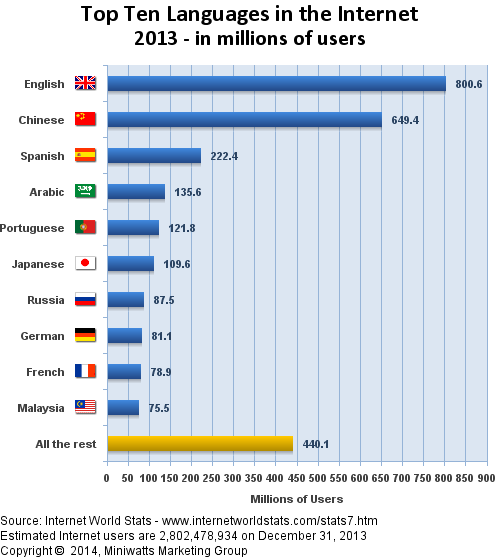
systems and technology. From 2000- 2014 Africans internet use grew +6000% and
Asia’s grew +1000%! World internet use
from: www.internetworldstats.com
Should
you translate your website?
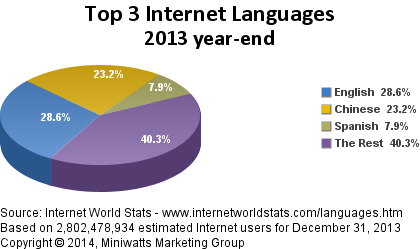
More than 70% of users speak languages other than English. Other
languages are resourced more than English and growing presences on the web.
Over 95% of consumers are outside of the U.S. By eliminating
the language barrier, you have created a multitude of opportunities.
75% of web users state they buy from sites in their native
language.
This is the age of the internet, many business people (>50%)
engage, shop and purchase on the internet. If you are not telling your story in
the consumer’s language, you will lose that sale, connection and future sales.
Most clients state once they start translating their export
sales increase comparatively to their U.S. sales each year.
Adding as little as 8 languages will increase your viewers
to 80% of the world’s population.
About the Author:
Linda Richardson is the President and owner of All Clear Translations, LLC. Since 2010 the team of All Clear Translations had helped companies grow into areas like Colombia, Brazil, Mexico, Canada, France, Switzerland, Germany, Greece, Morocco, Saudi Arabia, China, Malaysia, Thailand, Taiwan, Japan, Russia and more. Their translations and localization transform websites, software, technical manuals and marketing materials into all languages helping to increase sales. Their unique process can include Plain English to help companies increase understanding and comprehension while reducing translation and production costs of manuals. Their audio voice-over technologies and video translations enable spoken and written communication in many languages. Email Linda at linda@allcleartranslations and visit their website http://www.allcleartranslations.com
Global Trends for Exporting in 2015
Emerging Countries are ripe with potential for exporting. Our clients are entering markets like Brazil, Colombia, Malaysia, Thailand, and Morocco. Working with our U.S. clients who are selling worldwide we have compiled a list of languages and regions to help you grow your global marketing with translation.
Canada and Mexico – are largest trading partners. This is a great way to start to export. Ease of shipping, resources to help and need for our products makes them natural jumping points for many of our clients.
U.S. population – You are right, this isn't an export region but in California 44% of its population speak another language other than English at home. Laredo Texas has 92% of its population speaking another language at home. Highest percentage of languages spoken at home are Spanish (37.6 million), Chinese (2.9 million), Tagalog (1.6 million) Consumer goods and Healthcare companies especially are reaching out to people here in the U.S. translating into Spanish, Chinese, Korean, Vietnamese, Russian and more. I was recently in Miami and heard Spanish more than English everywhere.
Asia remains a growth area for our clients.
Even with the lower projections for GDP growth, China has a large presence globally and will be a great market for some of our clients. The written language used is simplified Chinese. India’s population is booming and their need for water, healthcare and infrastructure solutions has them engaging our U.S. companies to help build their economy. Thailand, Taiwan, Indonesia, Malaysia, and the Philippines are buying more products like software solutions, medical devices and automation for their manufacturing.We are seeing more demand for these languages from our clients.
Germany – Germany is the largest buying power in Europe for Robotics and Hi-tech manufactured products. There are many German companies based in the U.S. and ease of entrance is possible.
Brazil – Brazil has so much going on! In 2016 they host the Olympics. To do this, they are reaching out to our U.S. clients for solutions that range from engineering to manufacturing. Brazilian Portuguese is the official language and you will not do business there without feet on the street. Luckily, our US Commercial service and PA reps will help you build a marketing plan and sales.
Africa – Morocco and South Africa. African companies and economic development organizations are looking for U.S. resources to help build infrastructure, agricultural upgrades, manufacturing and services. Use of the smartphone has created new solutions like: Online Banking, mobile applications, online shopping and more. Software and mobile application companies who can enable this population to connect with new products and services will find this a growth market. Now people are more connected than have toilets! African countries are looking for help to build their infrastructure, agricultural solutions, service solutions with American technology.
Stop and consider your new market possibilities in 2015. Perhaps there is a trade mission, grant opportunity or buyer conference that by attending will open doors to new business? Employing new strategies to open these markets, you will find translating your marketing materials, videos, and product information a catalyst to blow open your sales goals and marketing ROI. All Clear Translations wishes you a successful and abundant year! Make it, translate it and they will BUY it!
Top 7 Languages for 2015
Spanish for Latin America and South America French For Europe and Africa German Portuguese (Brazil) Chinese (Simplified) Thai Malay
Our Resource Partners will educate you, help you find funding, connect you:
State and Federal Resources available
About the Author:
Linda Richardson is the President and owner of All Clear Translations, LLC. Since 2010 the team of All Clear Translations had helped companies grow into areas like Colombia, Brazil, Mexico, Canada, France, Switzerland, Germany, Greece, Morocco, Saudi Arabia, China, Malaysia, Thailand, Taiwan, Japan, Russia and more. Their translations and localization transform websites, software, technical manuals and marketing materials into all languages helping to increase sales. Their unique process can include Plain English to help companies increase understanding and comprehension while reducing translation and production costs of manuals. Their audio voice-over technologies and video translations enable spoken and written communication in many languages. Email Linda at linda@allcleartranslations and visit their website http://www.allcleartranslations.com
Ohio State officials are looking for companies to pair with interns for exporting help. The companies need to apply before December 10 to be considered. This is a great way to get help with exporting compliance, analysis, marketing and creating a compliance manual to name a few ways students help. This program reimburses the company 50% of the paid intern's wages.
As a consultant who works with companies new to translation, I often see company associates in a learning curve, trying to juggle compliance, marketing and more. Utilizing this program gives people involved in export access to someone who will dedicate their time to your specific export need. They are involved completely in your export process and have access to great resources within the state and university system. They are able to research your specific need/problem/issue and take action to successfully complete the project.
This resource is far more valuable than just the 50% reimbursement. The workload the student is able to take on, frees time for your associates to dedicate their resources to other projects concerning exporting.
I have talked with several companies who have taken advantage of this resource and the service was deemed as highly productive and helpful to grow a new market. I recommend inquiring with the State to apply to participate in this program.
Ohio Export Stats: http://development.ohio.gov/files/research/B2004.pdf
YouTube http://ow.ly/E25cO
Ohio was the 9th largest exporting state.
211 countries and territories received exports from Ohio.
9 countries received over $1 billion in Ohio exports.
Also if you are in the Youngstown region be sure to connect with Mousa Kassis at YSU for more information . They have an amazing exporting focus and will be your best advocate!
Contact us if you would like to learn more about adding languages to your website, marketing materials and more. The sooner you connect with us, the better your transition will be to other languages. We will give you the tools to write your English content for translation, saving you time and money! Email me directly, linda@allcleartranslations.com.
Wishing you much success in exporting,
Linda Richardson
Don't stop at English. Expand your market! When developing software here are 3
key things to keep in mind.
1.TARGET - Most probably your target is not just the U.S. Keep in mind future growth and where that growth will come from. Who
are your targets? Where do they come from? Who will be using your product? Over
two thirds of buying power comes from foreign countries.
2.LANGUAGE OF YOUR TARGET(s) – Now and future sales need to be considered
when developing your software. Is there
room for an expanded language, have you thought about adding software translations? Does your new market target use Latin, Cyrillic, Asian
or Arabic characters? Is your technical writer and software designer aware of the
complexities of adding other languages? Can your software handle bi-directional
or Asian characters?
http://www.sba.gov/content/explore%20-exporting
The U.S. Commercial Service has an export readiness assessment tool online.
This is a good start to help you determine where, what languages, etc.
3.INDUSTRY – Will you be selling your software
across Industries? Is your terminology general enough or too specific to easily
translate to other industries? We have a client with an asset tracking tool that we are
translating into several languages. This tool can be utilized across vertical
industries. Instead of naming the specific asset the software tracks currently,
we developed a more generic term that still conveys understanding in several
languages for different industries. Initially, the client took the time to help
us understand what they are doing now and where they wish to go in the future. Because we have met with them, talked with
them about future value and vision of their company and products, our translators created an effective communication
tool to be utilized across several platforms. Helping your Translations team
understand what you are working on now and what you see as a future application
will enable better communication now. This step will save you money and time as well as the
headache of re-working your software to fit new markets/regions.
To learn more about developing International ready software
contact me at linda@allcleartranslations.com
or 866-489-9109 to talk about increasing sales.